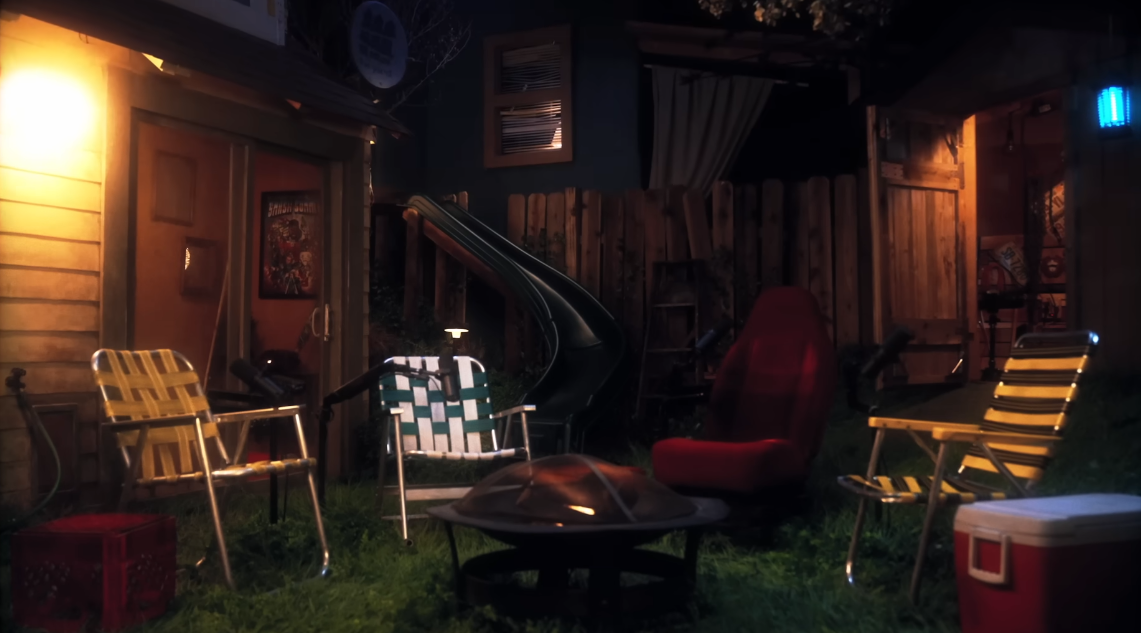
PHOTO: THE YARD
There was something that sparked in me when Slime said that. I looked up, and took in the landscape around me for the first time. Rolling hills and mountains sprawled in every direction, and yet somehow there was no towering landmark to truly set it apart from any other suburban-California purgatory. This fuckass neighborhood felt so long and wide, me by myself near the top of one of those hills, cold wind pushing me from behind. I was having one of those moments where I was realizing my entire life had brought me to where I was at that very moment: back from college, in a place where there was truly nothing, and no one, left for me. I felt small, then smaller, then somewhat normal again. Aiden and Slime’s voices came back into focus. “Denver is the Israel of the United States,” Slime was saying.
Just four months ago, “The Yard” was an entity that only existed in the periphery of my YouTube algorithm, subtly aligning itself with the Twitch streamers and the soothing slop content of that vein that I had already been watching at the time. Fast-forward to now, and I’m on the fifteen-dollar monthly tier of their Patreon, so I can listen to four sensitive white boys talk for ninety more minutes and also watch them play Dungeons & Dragons, which I had never previously been remotely interested in, a week before the same episodes come out on YouTube. How did I get here?
Ludwig Ahgren, Aiden “Calvin” McCaig, Anthony “Slime” Bruno, and Nick “Falco” “Envy” Vercillo were roommates, once upon a time, who met because of “Super Smash Bros. Melee,” that iconic fighting game for the Nintendo GameCube. The particulars of how they met and merged into the quartet they are today are irrelevant, although that lore is public. What is relevant is what happened after they started living together: Ahgren blew up as a Twitch streamer. By that point, long-time viewers of Ahgren had become quite familiar with his roommates, who naturally became fixtures of his livestreams. (Bruno, especially, had had a long history in the Melee community, having run a fairly popular podcast called “Bad Melee,” as well as being a frequent Melee tournament commentator and general on-stream duo with Ahgren — to the extent that “Slime’s friend Ludwig” used to be a bit on Ahgren’s stream.)
Their newfound — much broader — fame in hand, their next step was a foregone conclusion; white boys will be white boys. On 29 June 2021, “The Yard” posted its first video to YouTube: a short sketch that set the stage for the four’s dynamic for years to come. Then came the first proper episode, “shingle bells,” on 8 July 2021.
VIDEO: THE YARD/YOUTUBE — shingle bells
It’s been four years and then some since that first episode, and “The Yard” is now the highest-earning creator on Patreon, at least among those who make their earnings publicly available. As of the time of publication, the podcast has 42,189 paying members (the seventh most of any Patreon creator) that earn them a total of around $279,000 a month. Multiply that by twelve, then add the profits from the YouTube views and from sponsorships, then add the profits made from merchandise sales by Ahgren’s company Mogul Moves, then divide that among the four members plus the behind-the-scenes crew (at the very least, the onsite producer and the editor) — any way you slice it, that makes for a cushy salary for what amounts to sitting on a lawn chair and talking to your friends through a Shure mic. And yet here I was, paying my own money for exactly that. Clearly, then, there was some other factor, besides being “Ludwig’s podcast,” or the guest appearances, or even the comedy, that has drawn myself and tens of thousands of others to keep watching, and to turn “The Yard” into something of a lasting empire (to be a little dramatic). What was that?
I’ve had a particular affinity for podcasts for a while now. My earliest exposure to this sort of format and vibe was “The Basement Yard,” a weekly series where two childhood best friends from Astoria, Queens, Frank Alvarez and Joe Santagato, seem to just turn on the camera and banter for an hour. You almost forget, if you listen to them say all the insane things they say, that both are in their thirties and Alvarez is a married father of two. The appeal is simple and immediate: you’re thrust into the very real friendship between two men, and you get to be the hypothetical third person in the room, laughing and crying at the same things they do. The business model, at its core, is selling friendship. Not friendship between one person and yourself, necessarily, but an existing friendship between two people that you can find a great joy in observing.
This is not revolutionary, obviously: fictional shows like “Friends” (it’s in the damn title), “Seinfeld,” “Community,” and “The Office” have been known to find immense success in displaying convincing relationships between characters — platonic or romantic — in which viewers could become deeply invested. But precisely because these were fictional works, there still existed that barrier where the manifestations of those dynamics started and ended on-screen. This didn’t stop people from fantasizing about characters’ lives beyond the canons — hence why fanfiction exists — or even projecting the characters onto the actors themselves, clawing for any hint that the real-life counterparts were also close in a similar way and continuing to find satisfaction in that. Cast reunions and various public appearances catered to that desire, but there were limits to such things.
Two major changes have happened in the entertainment space since then. The first is that algorithmically powered platforms have so fragmented public interests and media consumption patterns that it is difficult to imagine a show like those mentioned receiving that degree of universal attention ever again. The second is that, because those platforms have become so enshittified over the past several years, people are now craving more desperately than ever for something that feels more real and authentic. Even podcasts, if you’re looking in the wrong places, are all trying to sell you something, or to get something out of you. I guess I can tolerate being advertised to every once in a while; but most of the time, I just want to vibe. I just want to feel attached to something real.
Objectively speaking, it is true that podcasts like “The Basement Yard” and “The Yard” fill this niche effectively, and have found sizable audiences because of it. (The former boasts more than 36,000 paid Patreon members with monthly earnings easily in the low six figures.) The similarity in names is coincidental, but they speak to the same sense of a shared male space, where the best conversations are had and the best memories made.
But the greatest reasons, I think, that I now find myself in this position are the personal ones.
I’ve always been somewhat obsessed with documenting the time I spend with friends. My memories of college and the people I met there are entirely structured through Instagram posts, screenshots of texts, pinned Discord messages, and some of the worst photos of any person to exist in the history of this planet. In larger group settings, though, I end up rarely speaking. It’s relaxing enough to listen in while the rest of my friends talk to each other — almost like a podcast.
In college, I didn’t watch “The Yard” because I felt I didn’t need it. But once I graduated and those social opportunities became fewer and fewer, it gave me exactly what I was missing: a look into another intimate universe of shared inside jokes, funny moments, and overall camaraderie that I could tap into at any moment. (And indeed, much like my own digital troves of memories that I could look through to reminisce on things, The Yard
’s community has their own custom-built search engine for every episode of the podcast.) The Yard,
as a slice of that universe that they choose to put out into that world, is a comforting reminder of my own.
I used to consider this a more or less unintentional parasocial consequence of the podcast. But it was surprising to hear from McCaig that the desire to share one's friends with the world was a mutual one:
VIDEO: THE YARD/PATREON — Ep. 150 Premium - Aiden speaks to a therapist [VIDEO]
There was one final thing that cemented my fondness for The Yard.
Bruno’s father had passed away in 2022, a few months after the podcast started. By the time I started watching, it had become a fixture of Bruno’s lore and the go-to edgy joke he could make to get a laugh. But at some point, as I was catching up to the older episodes, I came across a Medium post that Bruno had written — his only one. Eulogy for a Gambler
was the title.
It was a stunningly tender and affectionate portrait of a man from a son who had something of a reputation for being jokey and silly and also prone to rage. It also reminded me, to a degree I hadn’t felt in many years, of my own deceased father. My dad died when I was far too young to have a fuller perspective on who he was and what he meant to me. When you’re fourteen, your dad is your dad. I never had the opportunity to share memories with him as equals, adult to adult. But Bruno did — and yet, even he had his regrets.
I told him, “One day you are going to die, and I won’t ever know who you are. You’ve never had a serious conversation with me.”
He got quiet and stared out of the window for a few beats.
“I’ll tell you one day,” he said.
He never did, but what he said that day was enough.
I saw in Bruno that little piece of myself, of what could’ve been with me and my dad. I saw in the four of them a resemblance to my own friends, and what we could be like years down the line. But that meant we'd have to continue being friends for that long, and the future is such a fickle and uncertain thing. Episode after episode of The Yard
gives the impression that the guys would be friends forever, but who really knows? We’ll jokingly ask the question, ‘Will we be friends forever?’
McCaig says at one point, in the same Patreon episode. He then chokes up a little. And … I hope so. I really hope so.
All one can do, really, is hope. For now, though, there is the present. There’s the friends and the memories we have at this very moment. And there’s this week’s episode of The Yard.
■
Advice Show
do podcast The Yard
do app Patreon no meu celular. Normalmente, este é um podcast com quatro pessoas, sentadas em cadeiras de jardim, tagarelando sobre donuts de matcha e porra e se os seus convidados, apesar do gênero, são circunciados ou não. Mas esta série em particular apresenta apenas duas dessas quatro, que se tinham enfiados num armário claustrofóbico mas decorado ordenadamente. Um deles, Slime, completamente reclinado num banco com as suas pernas expondos no ar, faz uma píada vulgar dessas pernas mesmo por um tempinho — You get the whole turkey tonight, bitch
— e depois diz, A gente básicamente faz OnlyFans mas para fingir ter amigos.
O outro, Aiden, leva um momento para processar. Oh, tá certo, né … Porra. É verdade.
Houve algo que brilhou em mim quando o Slime disse isso. Olhei para cima, e absorvi a paisagem ao redor de mim pela primeira vez. Montanhas e colinas ondulantes espalharam em cada direção, e ainda assim, por alguma razão houve nenhum marco alto para se diferenciar de qualquer outra purgatória suburbana da Califórnia. Essa porra do bairro pareceu tão longo e largo, eu sozinho em cima de um dessas colinas, vento frío me empurrando de atrás.Eu estava tendo um desses momentos onde estava percebendo que a minha vida inteira me tinha trazido para onde eu estava nesse momento mesmo: voltado da faculdade, em um lugar onde não havia realmente nada, e ninguém, que sobrou aqui para mim. Senti-me pequeno, e ainda mais pequeno, e depois um pouco normal de novo. As vozes do Aiden e do Slime voltaram ao foco. Denver é o Israel dos Estados Unidos,
o Slime estava dizendo.
Há só quatro meses, The Yard
era uma entidade que existiu apenas na periferia do meu algorítmo do YouTube, sutilmente se alinhando com os streamers na Twitch e esse slop calmante dessa maneira que já assistia no momento. Avance para o presente, e estou no nivel de quinze dólares do seu Patreon, para que eu possa escutar a quatro sensitive white boys falarem por noventa minutos mais e também assisti-los jogarem Dungeons & Dragons, em que eu não tinha nenhum interesse no passado, uma semana antes dos mesmos episódios lançarem no YouTube. Como é que cheguei até aqui?
Era uma vez, Ludwig Ahgren, Aiden “Calvin” McCaig, Anthony “Slime” Bruno, and Nick “Falco” “Envy” Vercillo eram colegas de quarto, que se conheceram graças a Super Smash Bros. Melee,
esse jogo de luta icónico para o Nintendo GameCube. Os particulares de como eles conheceram e se fundiram ao quarteto que são hoje em dia são irrelevante, porém esse lore já é público. O que é relevante mesmo é o que aconteceu depois que eles começaram a viver juntos: Ahgren viralizou como um streamer. Nesse ponto, os viewers de longa data do Ahgren já se familiarizaram muito bem com os colegas de quarto dele, que naturalmente se tornaram parte fixa das suas lives. (Bruno, especialmente, já tinha uma longa história na comunidade de Melee, tendo feito um podcast meio popular chamado Bad Melee,
além de também ser um comentarista frequente de torneios de Melee e duo geral com Ahgren nas lives, ao ponto de que Slime's friend Ludwig
virou uma piada recorrente na live do Ahgren.)
Com a fama nova — e muito mais ampla — na mão, o próximo passo deles foi uma conclusão inevitável; white boys serão white boys. No dia 29 junio 2021, The Yard
postou seu primeiro video no YouTube: um esquete curto que preparou o caminho para o dinámico dos quatro pelos próximos anos. E depois, veio o primeiro episódio de fato, shingle bells,
no dia 8 julio 2021.
VIDEO: THE YARD/YOUTUBE — shingle bells
AHGREN: Espero que esse podcast se torne lucrativo. Vocés já sabem o que é o meu objetivo com esse podcast?
VERCILLO: O quê?
AHGREN: Quero que todos vocês ganhem bastante dinheiro que cheguem a esse podcast — você [Vercillo] em particular — e ganhem mais do que ganharia dos seus trabalhos regulares, e trabalhem muito menos, e fiquem tipo, "Porra, tenho que trabalhar das 9 às 5 em vez de só sentar lá em cima no meu sótão por uma hora e ganhar tanto quanto." …
Há quatro anos e ainda mais desde esse primeiro episódio, e The Yard
já está o criador do Patreon que mais ganha, pelo menos entre os que fazem públicos os seus rendimentos. No momento de publicação, o podcast tem 42.189 membros pagantes (o sétimo mais de qualquer criador do Patreon) que lhes rendem cerca de $279.000 (R$1.5 milhões) por mês. Multiplique isso por doze, e adicione os lucros das visualizações no YouTube e dos patrocínios, e depois adicione os lucros das vendas de mercandoria pela empresa do Ahgren, Mogul Moves, e depois divida entre os quatro membros mais a equipe deles (pelo mínimo, o producer e o editor) — por qualquer jeito que divida, é um salario bem confortável para o que equivale a só sentar em uma cadeira de jardim e falando com os seus amigos por um mic Shure. E ainda assim, aqui eu era, pagando o meu próprio dinheiro por exatamente aquilo. Então, claro que havia algum outro fator, além de ser o "podcast do Ludwig," ou as participações dos convidados, ou até a comédia, que convenceu a mim e dezenas de milhares de outros a continuar a assistir, e que se tornou The Yard
em algo como um império duradouro (sendo dramátiquinho). O que é que era?
Já tenho tido uma afinidade para podcasts por um longo tempo. A minha exposição primeira a esse tipo de formato e vibe foi The Basement Yard,
uma série semanal onde Frank Alvarez e Joe Santago, dois amigos melhores de Astoria, Queens, Nova York, parecem a só ligar a câmera e brincar por uma hora. Quase se esquece, se ouve pra eles falando todas as coisas insanas que falam, que ambós são nas suas trintas e o Alvarez é casado e pai de dois filhos. O apelo é simples e imediato: é lançado na amizade bem real entre dois garotos, e pode ser a terceira pessoa hipotética na sala, rindo e chorando das mesmas coisas que eles. O modelo de negócios, no fundo, é vender amizade. Nem amizade entre uma pessoa só e você, necessariamente, mas uma amizade existente entre duas pessoas que pode encontrar uma alegria grande em observar.
Isto não é revolucionário, claro: séries fictícias como Friends
(é no título mesmo), Seinfeld,
Community,
e The Office
eram conhecidos por conseguir sucesso imenso em mostrar relacionamentos convincentes entre personagens — platónicos ou românticos — nos quais os espectadores poderiam ficar profundamente envolvidos. Mas precisamente porque aqueles foram obras fictícias, ainda existia essa barreira onde as manifestações desses dinámicos começaram e terminaram na tela mesmo. Isso não impediu as pessoas de fantasiar das vidas de personagens além dos canons — é por isso que existe fanfiction — ou até projetar as personagens aos atores mesmos, buscando desesperadamente qualquer sugestão que tinha uma amizade parecida entre as suas equivalentes na vida real e continuar encontrar satisfação assim. Reuniões dos elencos e várias apresentações publicas alimentaram esse desejo, mas haviam limites a coisas assim.
Aconteceram duas grandes mudanças no espaço de entretenimento desde então. A primeira é que plataformas alimentadas por algorítmos já têm tanto fragmentados os interesses públicos e padrões do consumo de mídia que é difícil imaginar que uma série como aquelas mencionadas volte a receber esse grau de atenção universal.A segunda é que, porque essas plataformas se tornaram enshittificadas pelos últimos anos, as pessoas já estão querendo, mais desesperadamente do que antes, algo que sente mais real e auténtico. Até os podcasts, se buscar nos lugares errados, estão tudo tentando vender alguma coisa para você, ou tirar algo de você. Acho que consigo tolerar ver um anúncio de vez em quando; mas na maiória das vezes, só quero curtir a vibe. Eu só quero me sentir ligado a algo real.
Falando objetivamente, é verdade que podcasts como The Basement Yard
e The Yard
ocupam efetivamente esse niche, e conseguiram audiências consideráveis por essa razão. (O primeiro possui mais de 36.000 membros pagantes no Patreon, que os rendimentos mensais estão facilmente nos seis digítos de dólares.) A semelhança nos nomes é coincidental, mas eles apelam ao mesmo sentido de um espaço masculíno compartilhado, onde são tidas as melhores conversas e são feitas as melhores memórias.
As maiores razões, embora, eu acho, por eu me encontrar nesta posição são as mais pessoais.
Sempre fiquei obcecado em documentar o tempo que eu passo com amigos. As minhas memórias da faculdade e as pessoas que conheci lá são estruturadas inteiramente por posts no Instagram, capturas de tela de mensagens de texto, mensagens fixadas no Discord, e uns das piores fotos de qualquer pessoa que existe na história da terra. Nas situações com grupos maiores, embora, acabo raramente falando. Eu acho bastante relaxante apenas escutar enquanto o resto dos meus amigos conversam entre si — quase como um podcast.
Na faculdade, não assisti The Yard
porque pensei que não o precisava. Mas depois que eu me formei, e houve cada vez menos dessas oportunidades sociais, ele me deu exatamente o de que eu estava faltando: uma olhada para um universo íntimo de piadas internas compartilhadas, momentos engraçados, e camaradagem geral que eu poderia acessar a qualquer momento.
Isso eu considerava mais ou menos uma consequência parasocial não intencional do podcast. Mas fiquei surpreso ouvir do McCaig, num episódio no Patreon que ele fez sozinho, que o desejo de compartilhar os seus amigos com o mundo era mutual:
VIDEO: THE YARD/PATREON — Ep. 150 Premium - Aiden speaks to a therapist [VIDEO]
McCAIG: Uma coisa de que gosto muito sobre este show é que há tipo um elenco secundário de personagens. E eles são simplesmente pessoas importantes nas nossas vidas com quem a gente tem muita proximidade, e a gente tem sido capaz de integrá-los no show com o tempo. Acho que a gente simplesmente gosta de que outras pessoas podem ver quão engraçado e legal são pessoas tipo Josh, ou pessoas tipo Miles, e Yingling, entre outras, que podem visitar o show por um momento, e — da perspectiva dum viewer, acho que é fazer parte do universo? Mas estes são figuras importantes nas nossas vidas que a gente já conheceu há muito tempo. Por exemplo, tipo Josh é uma pessoa que eu conheci em 2016, em Perth, Austrália, e agora mora no sul da Califórnia como um jogador profissional de Melee, e a gente conseguiu manter contato pelo tempo inteiro, e ele sempre tem sido carismático e engraçado — ele pode vir e fazer parte disto aqui. E eu acho que essa ideia de que Anthony já discutiu, de poder exibir — por que não mostraríamos ou iríamos nas lives ou representaríamos quão engraçado é esta pessoa? Outros pessoas deveriam poder compartilhar em quão especial é esta pessoa.
Houve uma coisa final que consolidou a minha afeição por The Yard.
O pai do Bruno falheceu em 2022, uns meses depois que o podcast começou. Na altura em que comecei assistir, tornou-se um elemento fixo do seu lore e a piada fácil que ele poderia fazer para dar risada. Mas em algum momento, enquanto eu estava assistindo aos episódios mais antigos, encontrei um post no Medium que o Bruno escreveu — seu único. Eulogy for a Gambler
(Elogio para um Jogador) foi o título.
Foi um retrato surpreendentemente tendríl e afetuoso dum homem por um filho que tinha meia reputação por ser um idiota brincalhão e também propenso à raiva. Eu me lembrei também, até um ponto que não senti há muitos anos, do meu próprio pai falecido. Meu pai morreu quando era novo demais para ter uma perspectiva mais completa sobre quem ele era e o que é que ele significava para mim. Quando tem catorze anos, o pai é o pai. Nunca tive a oportunidade a compartilhar memórias com ele como iguais, adulto a adulto. Mas Bruno teve sim, e ainda assim ele tinha seus arrependimentos:
Eu disse a ele,
Um dia você vai morrer, e nunca vou conhecer vocè mesmo. Você nunca teve uma conversa séria comigo.Ele ficou quieto e olhou à janela por uns momentos.
Vou te contar algum dia,ele disse.E nunca contou, mas o que ele disse esse dia foi suficiente.
Eu vi no Bruno essa peça pequena de mim, do que poderia ter sido comigo e meu pai. Eu vi nos quatro uma semelhança aos meus próprios amigos, e como é que poderíamos ser anos depois. Mas isso significava que teríamos que continuar sendo amigos por todo esse tempo, e o futuro é uma coisa tão instável e sem certeza. Episódio após episódio de The Yard
dá a impressão de que os gajos seriam amigos para sempre, mas quem realmente sabe? A gente pergunta, brincando, ‘ Será que seremos amigos para sempre:
diz McCaig em um momento, no mesmo episódio Patreon. Ele então fica emocionado. E … Espero que sim. Espero muito que sim.
Tudo que se pode fazer, realmente, é esperar. Por enquanto, embora, há o presente. Há os amigos e as memórias que já temos nesse momento mesmo. E há o episódio desta semana de The Yard.
■